Pura Besakih Guide: 10 Things I Wish I Knew Before Visiting Bali’s Mother Temple
Last Updated on June 3, 2026
Are you planning a visit to Pura Besakih, in Bali, and looking for a complete guide on what to expect before you go?
Considered the holiest and most important temple complex on the island, Pura Besakih sits on the slopes of Mount Agung, bringing together 23 separate (but related) temples into one sacred site. Located in Besakih village, just a 40-minute drive from Sidemen, it’s absolutely worth a visit if you’re exploring eastern Bali.
However, my own visit, a full-day trip to Besakih from Ubud, didn’t exactly go as planned. That’s why in this Pura Besakih guide, I’m sharing everything I wish I had known beforehand, along with practical tips to help you plan your trip as smoothly as possible.
This article may contain affiliate links. This means that if you purchase through one of the links, I may be paid a small commission at no extra cost to you. Thank you for supporting the blog and allowing me to keep sharing meaningful travel experiences with you.
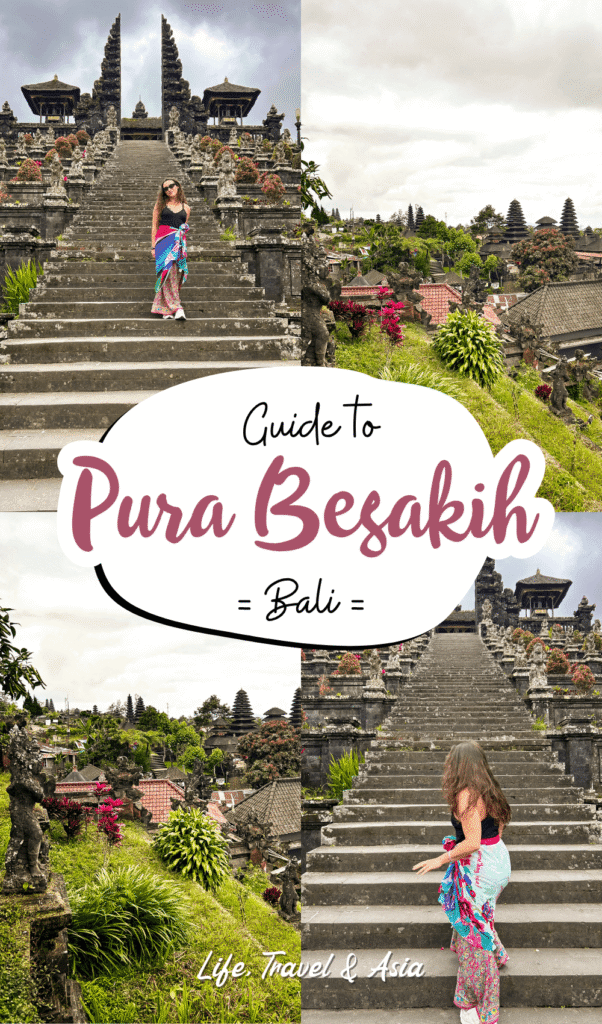
Don’t have time now?📌 Save it for later!
Recommended in This Article
History of Besakih Temple
Pura Besakih’s history dates back to the 8th century when an Indian priest, Rsi Markandeya, was guided to build a shrine on the slopes of Mount Agung. Because Agung is Bali’s highest peak, the location was chosen to represent a direct link between the earthly realm and the gods.
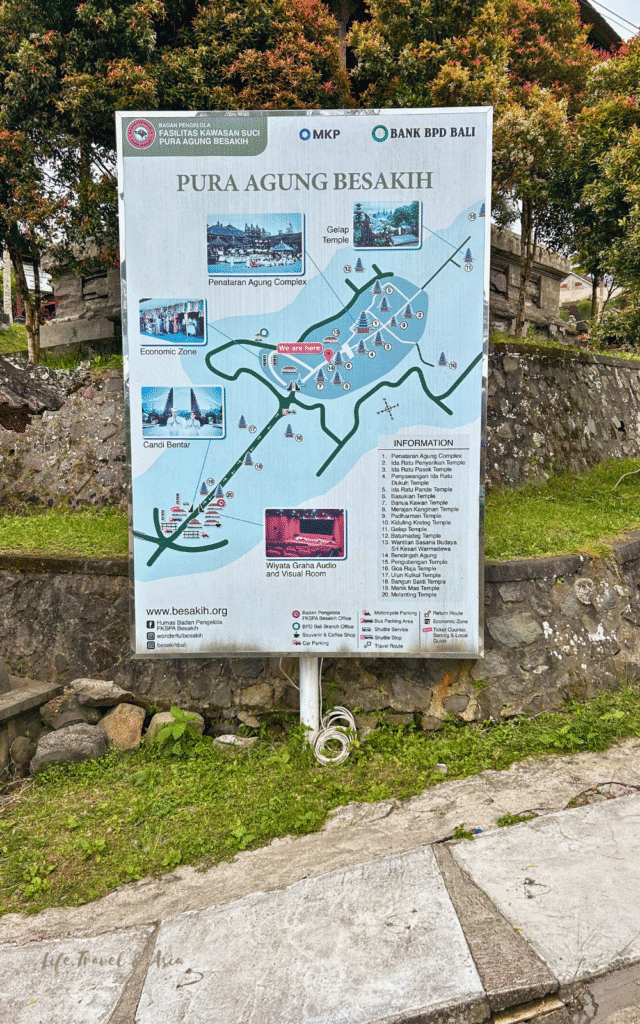
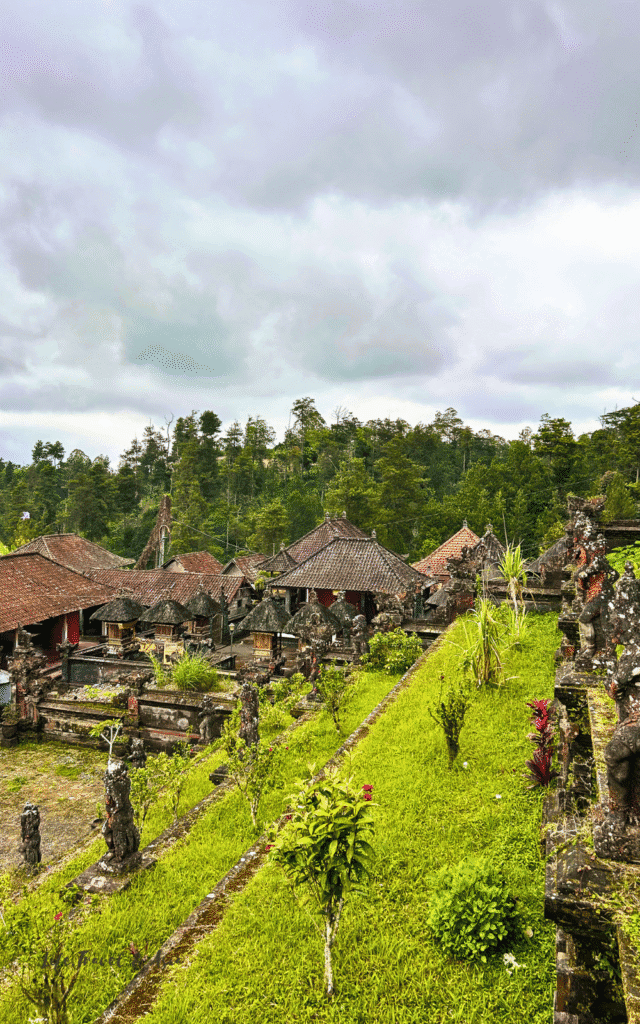
Over the centuries, that single shrine expanded into the massive 23-temple complex you see today, with Pura Penataran Agung serving as the main central temple for major ceremonies. While you can explore the complex, keep in mind that most inner courtyards are closed to the public and strictly reserved for local rituals.
Perhaps the most remarkable event happened in 1963. When Mount Agung violently erupted, destroying nearby villages, the lava flows miraculously missed the temple by mere meters. For the Balinese, this wasn’t a coincidence; it was a powerful reminder from the gods of the temple’s sacred significance.
Is Pura Besakih Worth Visiting?
Pura Besakih is absolutely worth visiting, not only because of its spiritual, cultural, and religious significance, but also due to its incredible location on the slopes of Mount Agung, which you can admire right behind the temple on a clear day.
A local guide is included in the ticket price, and this makes for the perfect opportunity to learn more about Balinese Hinduism as well as the history of the site; its legends, how it developed into a 23-temple complex, and the many special ceremonies held here.
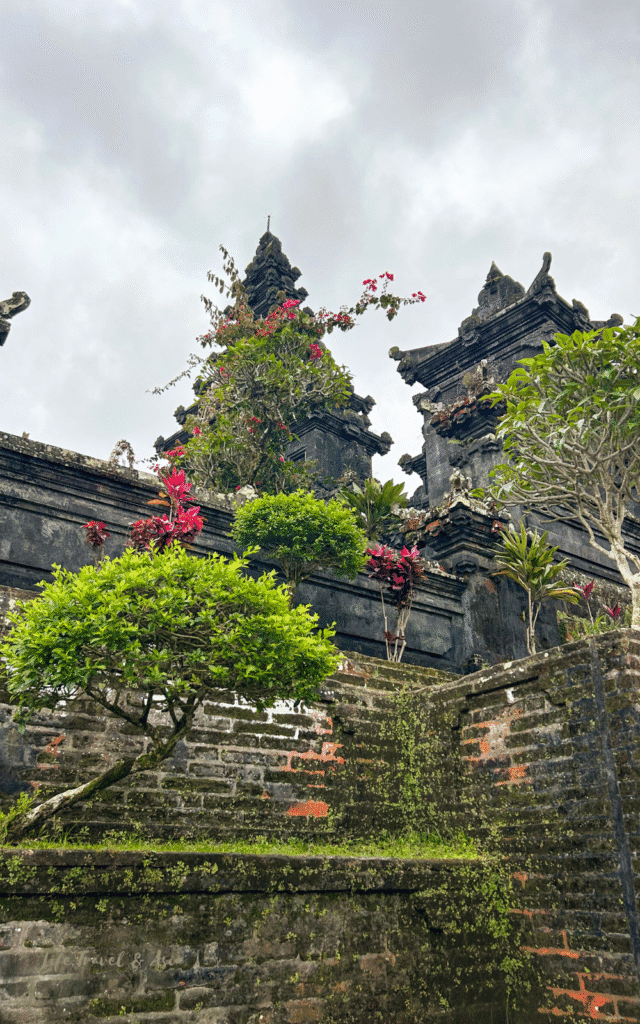
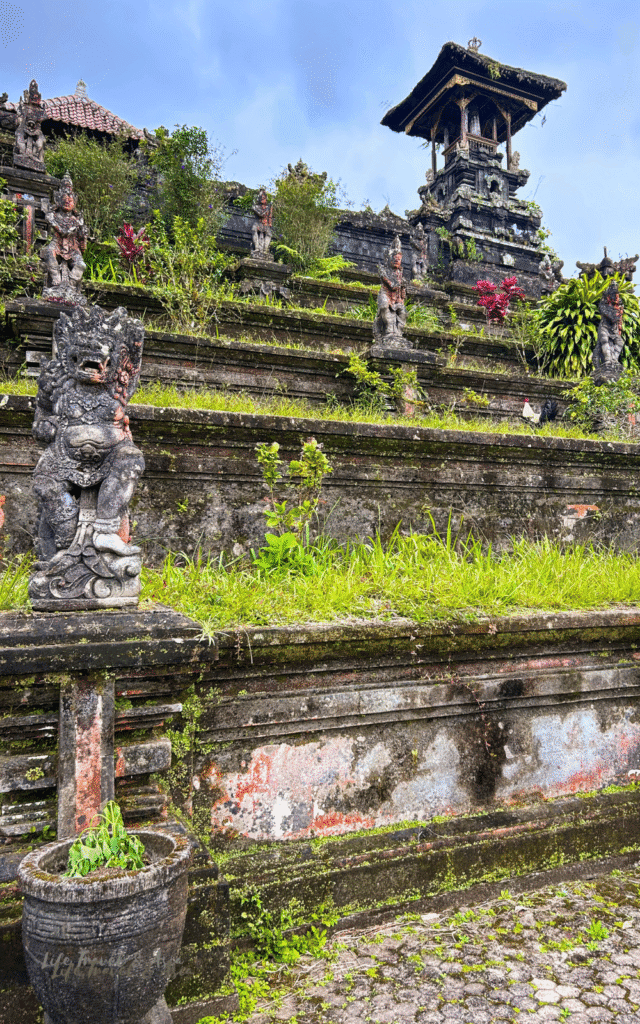
The temple complex is much larger than most temples you’ll visit in Bali, so going out of your way to see it is worthwhile if you want to experience one of the island’s most important religious highlights.
That said, I must admit that a visit to Pura Besakih is truly worth it only if you plan your trip carefully and avoid some of the mistakes I made.
My first tip is to visit Pura Besakih as part of a broader trip to East Bali.
If you’re planning a dedicated day trip from Ubud, things can easily go sideways. The distance is significant, and road conditions can heavily impact your travel time. When I visited, a road closure doubled our journey.
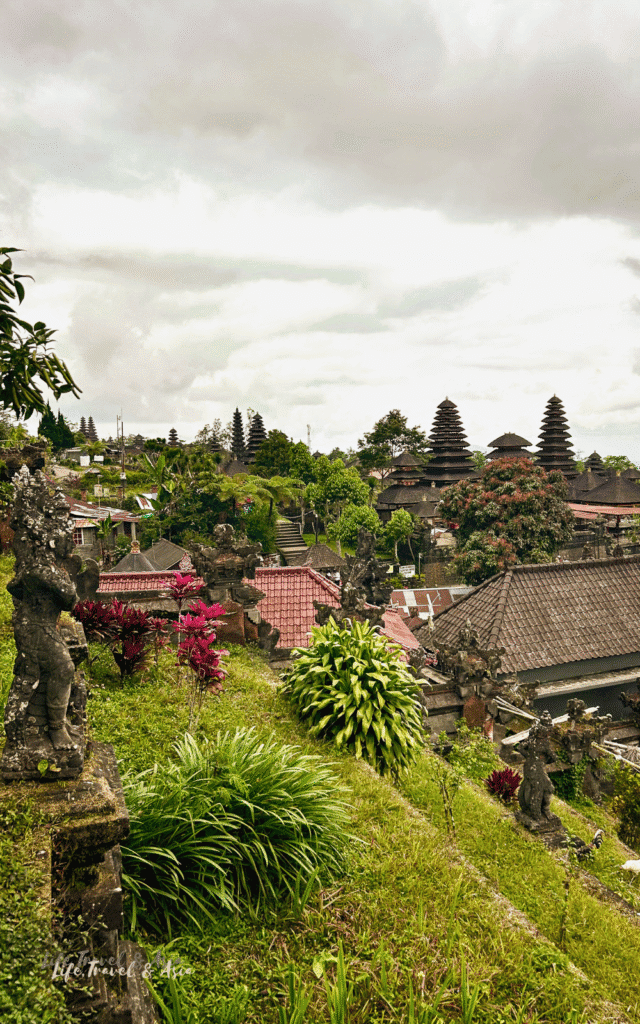
On a normal day, driving from Ubud to Besakih takes about an hour and a half, assuming you leave early enough to beat the town’s central traffic. For us, it ended up being three hours each way. Needless to say, Besakih was the only thing I managed to see that day.
Would I make that drive from Ubud again? Absolutely not. That’s why I only recommend visiting the Mother Temple if you’re already heading toward eastern Bali or planning a trip to Kintamani.
How to Get to Pura Besakih
Pura Besakih is located in eastern Bali, about 40 minutes from Sidemen and 45 minutes from Kintamani. If I had to plan my trip again, I would definitely start from one of these two locations.
There is no public transportation to the temple, so unless you’re renting a scooter, your best option is to hire a private driver. For the best experience, I highly recommend this service. It’s one of the most transparent I’ve found on the island when it comes to pricing and overtime charges.
Most car hire companies allow you to customize your itinerary and add multiple stops. Based on my experience, I recommend clarifying with your driver in advance whether all your planned stops are realistic, taking into account traffic and road conditions.
Pura Besakih Entrance Fee & Opening Hours
For foreign visitors, the entrance fee in 2026 to the temple is IDR 150,000 (about $9), payable by either cash or card. The ticket includes a wristband (which will be scanned again at the temple entrance), a sarong (though you can wear your own if you have one), and a one-way shuttle ride up to the temple.
The modern ticket office is located lower on the hill than the temple itself. From there, a shuttle departs every 10–15 minutes and takes about 5 minutes to reach the main candi bentar (split gateway).
For the return trip, the shuttle is not included. If you want to use it, you’ll need to pay an additional fee of IDR 20,000. Otherwise, you can walk back to the ticket office, which takes around 20 minutes.
The ticket also includes a local guide, who will ensure you don’t get lost, take you around the main areas, and provide an explanation of the temple’s history. As always, the experience depends on the guide; mine wasn’t particularly talkative, but you can ask as many questions as you like, and they’ll be happy to answer.
The Pura Besakih Scam: What to Watch Out For
As with many popular tourist attractions in Bali, scams can unfortunately happen at Pura Besakih.
- Sarongs: Decline any offers to buy a sarong outside the entrance. A sarong is already included in your ticket, so you won’t need to purchase one.
- Offerings: As you enter the temple, you may be “offered” a canang sari (Balinese offering) to buy. This is not mandatory to enter the temple.
- Photos: In front of Pura Penataran Agung, you may come meet people encouraging you to take the “famous” picture with the water reflection effect on the main stairs. You can choose to accept it or decline politely.
What to Wear: Pura Besakih Dress Code
As mentioned, a sarong is provided with the entrance ticket (though you can still wear your own if you prefer).
That’s essentially the only dress code requirement. However, it’s worth keeping in mind that Besakih is a very spiritual and significant site, so dressing respectfully is definitely the right thing to do.
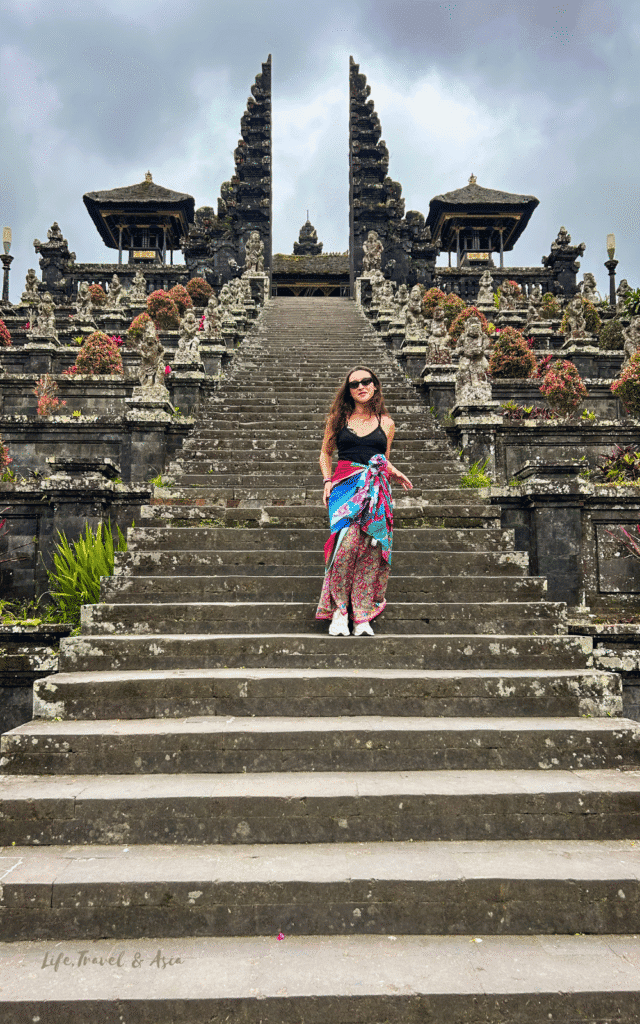
Covering your shoulders is not mandatory in Balinese temples—in fact, a local guide once told me it isn’t considered disrespectful—so you don’t need to worry about that.
Is Pura Besakih Crowded?
Pura Besakih is, of course, a very popular tourist attraction. However, outside of major ceremonies, the temple rarely feels overcrowded thanks to its size.
You may find queues in front of the main stairs of Pura Penataran Agung, which is usually the most popular photo spot, but overall, the crowds spread out well.
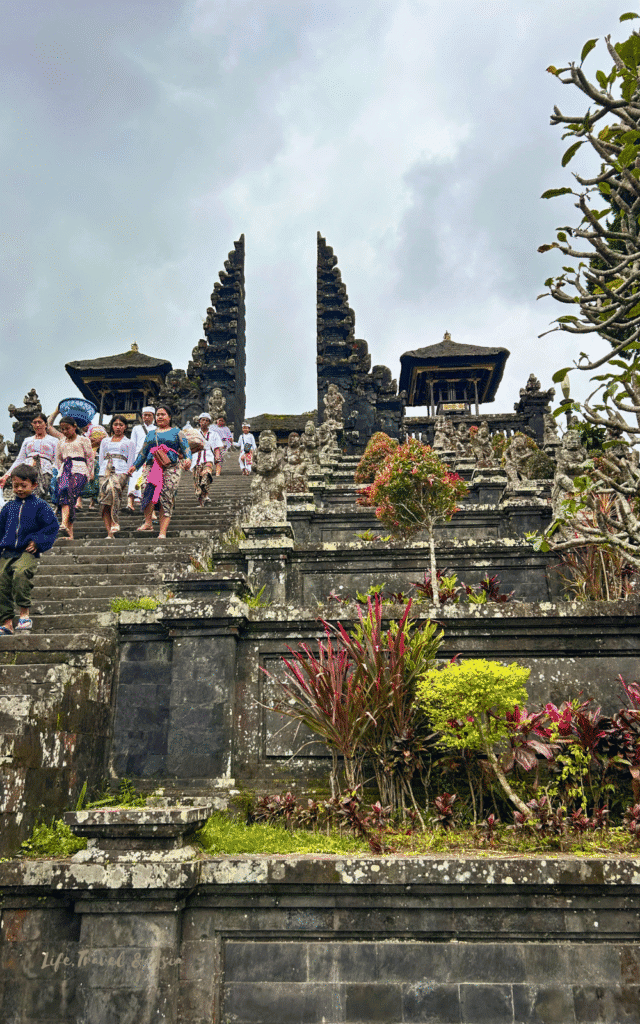
Things can be slightly different if you end up visiting the Mother Temple during a ceremony, where many locals travel to the Mother Temple.
In addition to major celebrations like Galungan and Kuningan, Pura Besakih also hosts many routine and special ceremonies throughout the year:
- Odalan Ceremony – Held every 210 days, it celebrates the temple’s anniversary. Many locals travel from their villages to take part in several days of festivities.
- Panca Wali Krama – A ceremony that takes place every 10 years.
- Ida Bhatara Turun Kabeh – Celebrated every 12 years, when sacred relics from temples across Bali are paraded to Pura Besakih (which means the temple can get very crowded).
- Eka Dasa Rudra – The holiest and most important ceremony, held once every 100 years.
How Long Does the Visit Take?
A typical guided visit lasts around 30 minutes. However, I highly recommend taking your time, asking as many questions as you’d like, and soaking in the atmosphere.
Since this is likely a once-in-a-lifetime visit, I suggest spending up to an hour here. That way, you can take photos, learn about the history and development of the site, and appreciate every detail.
Also, remember to consider the 15–20 minutes it takes to walk back to the parking lot.
Things to Do & See at Pura Besakih
Once you’ve purchased your ticket, put on your sarong, and been assigned a guide, you’ll reach the temple via a small shuttle that takes you to the main entrance.
This is where you’ll encounter most of the sellers offering souvenirs, snacks, and drinks. It’s also where the crowds tend to gather, especially for the popular ritual photos in front of the stairs of Pura Penataran Agung, the most important temple in the Besakih complex.
Pura Besakih is made up of 23 main temples spread across parallel ridges. In addition to these, there are around 70 secondary temples, which are private and belong to different regencies and caste groups.
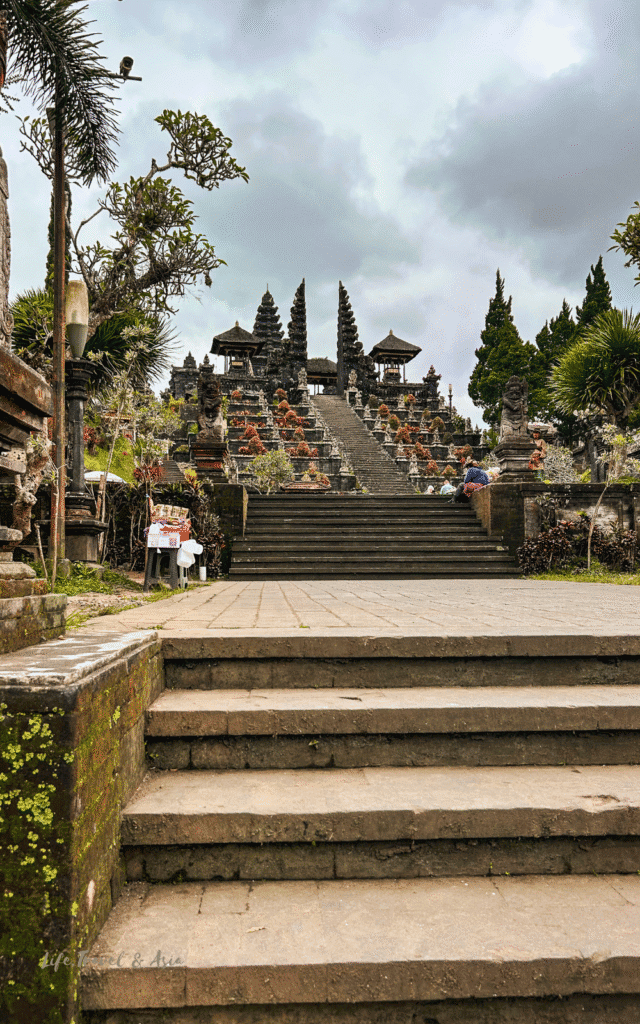
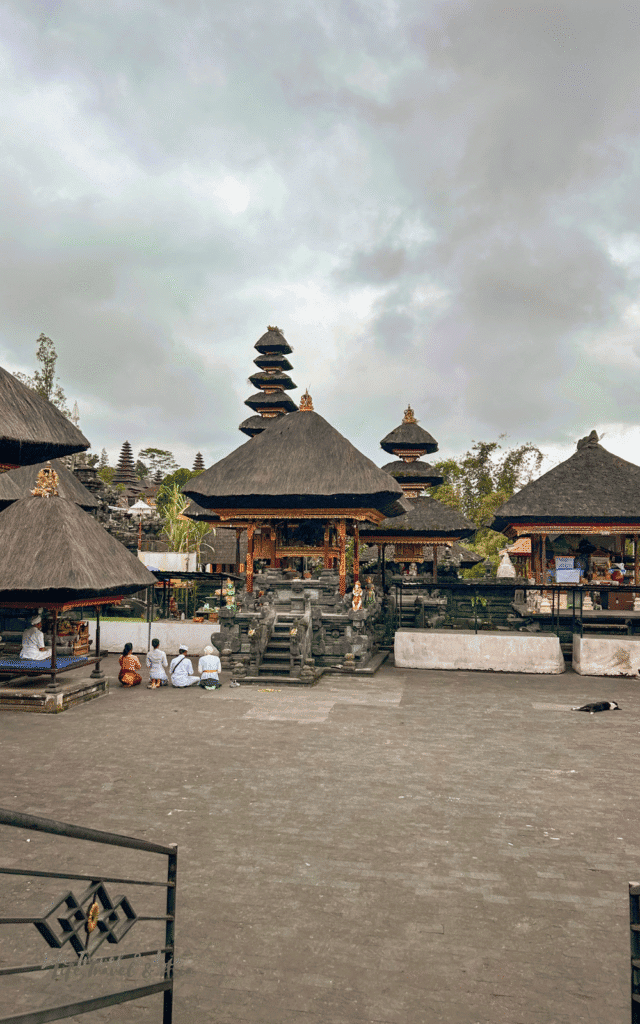
The visit typically focuses on the area around the main stairs—one leading up to the left of Pura Penataran Agung and one going down, symbolizing the ascension towards the divine as you visit the temple.
As you’ll notice, many of the temples are private and accessible only to locals, but it’s still possible to catch a glimpse of the inner courtyards from outside.
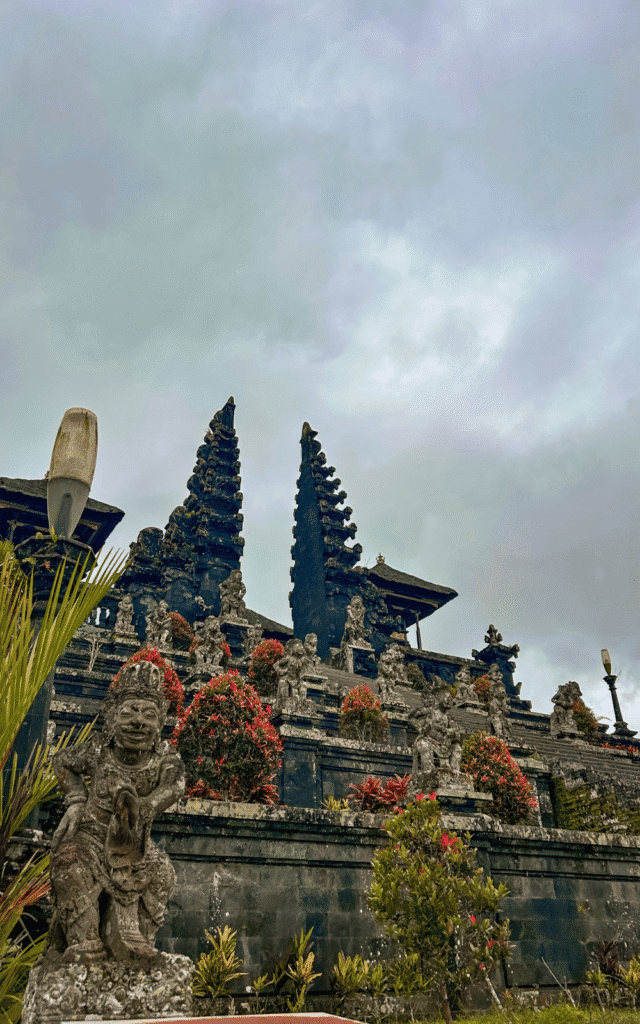
All around the complex, you’ll see numerous meru-style shrines, every storey dedicated to a specific deity, as our guide explained.
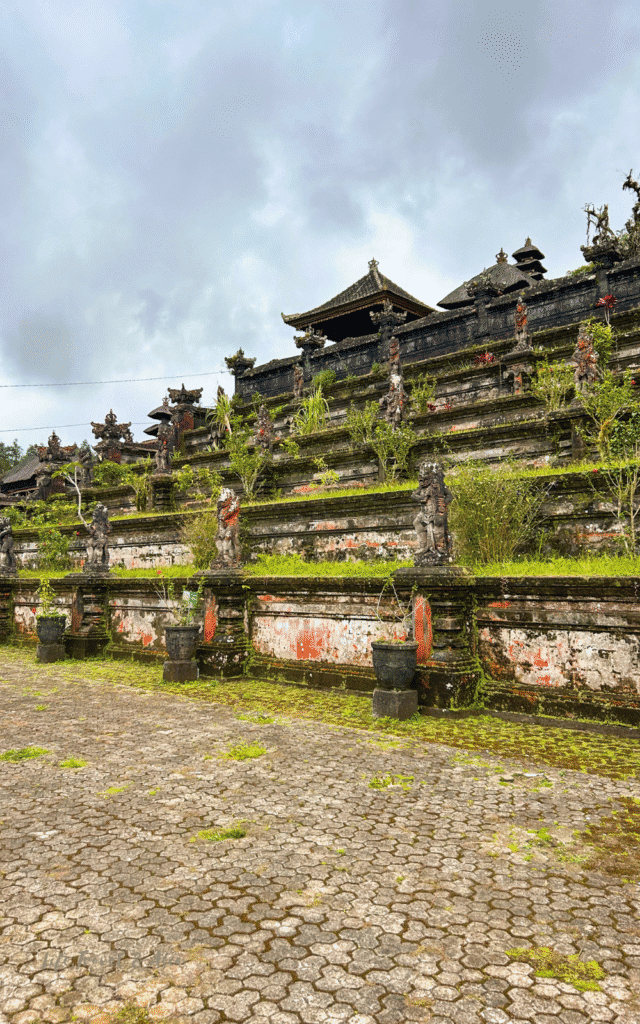
One of the unique features of Besakih is the black-colored temple walls, built and restored using volcanic stone.
During my visit, several restoration works were underway around the site. Since Besakih is such an iconic and significant place for Balinese Hindus, great care is taken to maintain its appearance.
On the way back to the entrance, your guide will direct you toward the ticket office, passing through a lane lined with souvenir shops and small cafés.
My Best Tips to Make the Most of Your Visit
- Be Respectful: This goes without saying. Pura Besakih is one of the most sacred sites in Bali. Show respect by behaving appropriately and keeping noise to a minimum.
- Take Your Time: Guided visits often move quickly, but don’t rush. The details, secondary temples, and smaller shrines all deserve your attention.
- Bring Some Cash: While tickets can be paid by card, cash is still necessary for small purchases and for paying the parking fee (if you’re using your own vehicle).
- Confirm Travel Times in Advance: Don’t rely too heavily on phone maps; locals usually know best how long it really takes to get somewhere. If you’re booking a driver, ask them to confirm that your planned itinerary for the day is feasible, taking into account traffic and road conditions.
- Don’t plan a day trip from Ubud, as travel times can feel very long
Best Tours With Besakih Temple
If you’re more interested in sights than in planning the logistics, here are some tours that include Besakih Temple. These could be ideal if the only things you want to worry about are taking pictures and exploring.
- Besakih temple, Tukad Cepung waterfall, Penglipuran: This is the tour I had planned for myself (if only the road hadn’t been closed that day!). It includes pick-up from Ubud, a visit to one of the most beautiful waterfalls in the area, and a stop at the charming village of Penglipuran.
- Besakih Temple, Tukad Cepung Waterfall & Rice Terraces: This tour combines some of the most iconic stops in East Bali. You’ll visit Pura Besakih, discover Tukad Cepung Waterfall hidden in a cave-like setting, and walk among the Tegallalang Rice Terraces, located north of Ubud.
There you go, my complete Pura Besakih Guide, written after visiting and realizing what I would have done differently.
The biggest takeaway? Don’t plan your day trip from Ubud, if possible. Visiting Besakih pairs perfectly with a stop in Sidemen or Kintamani, and that’s actually what I almost did after my trip through the Kintamani region.
If you found this guide useful, share it with your travel buddies, and if you have any questions about visiting the temple, drop them in the comments. I’ll be more than happy to help! 🌺
Other East Bali Reads to Inspire Your Trip
- Tirta Gangga Water Palace: Why It’s Still Worth Visiting Despite the Crowds
- 3-Day East Bali Itinerary: Explore The Authentic Side of Bali
- Guide to Gembleng Waterfall: Bali’s Enchanting Natural Infinity Pool
- Your Guide to Lahangan Sweet in 2026: The Best Viewpoint in East Bali
Did you find it helpful? 📌 Save it on Pinterest!