How to Prepare for Your STOTT PILATES Teacher Training: 5 Tips & Top Resources
Last Updated on October 9, 2026
Yes, I know what you’re thinking. At the end of the day, your STOTT PILATES training is just a course. There are no graded tests or formal exams during classroom hours.
However, how you approach it makes all the difference. In my STOTT Pilates Instructor Training Guide, I’ve already explained how the Intensive Matwork & Reformer Courses cover a massive amount of information in just a couple of weeks.
You can use that time to validate your existing knowledge, refine technical details, and walk away confident enough to practice teaching immediately. Or, you can walk in with minimal preparation, end up feeling overwhelmed, and find yourself needing months just to digest the basics before you ever teach a client.
We all start the teacher training with different timelines and expectations in mind. But if your goal is to start your Pilates teaching career right away and genuinely trust your skills from day one, you’re in the right place.
That is exactly how I approached my own training. And in this post, I’m sharing the tips and, most importantly, the exact resources that made my intensive training feel almost effortless (turning it into an opportunity to improve my practice rather than learning everything from scratch).
This article may contain affiliate links. This means that if you purchase through one of the links, I may be paid a small commission at no extra cost to you. Thank you for supporting the blog and allowing me to keep sharing meaningful travel experiences with you.
How to Prepare for Your STOTT Pilates Teacher Training: 5 Tips
1. Don’t Rush the Timeline
I officially enrolled in my STOTT Instructor training in January 2026, but the in-person course didn’t start until September 2026.
Initially, having that eight-month gap felt like the longest wait. It turned out to be the greatest advantage I could have given myself.
I began studying functional anatomy a full year before the training, back in September 2025 when I first made the decision to become an instructor.
Trust me on this: expecting to learn functional anatomy from scratch in just five or six days is unrealistic. If you don’t have a background in movement science, you’ll need at least six months to let the muscle actions, joint mechanics, and terminology actually sink in. (I’ll share the exact resources I used below.)
Because I put in that work, my Anatomy & Exercise Fundamentals course felt like a review rather than an overwhelming shock to the system. While many of my classmates were stressed and scrambling to memorize terminology overnight, I was able to confidently engage with the instructor at every class.
2. Practice on Your Own
Don’t just attend regular studio classes. While drop-in fitness classes are fun, they rarely follow the Pilates repertoire.
If there is a certified STOTT PILATES instructor in your area, prioritize their classes to start learning the exercise choreography, notice the movement principles, and observe their pacing and verbal cues.
If not, study the original classical Pilates repertoire on both Mat and Reformer; the STOTT method is deeply rooted in it. You can also find videos on YouTube and online platforms to practice the choreography.
Learning the choreography before the training makes all the difference. During training, you’ll be able to focus on the real work: breath patterns, client modifications, adjustments, and cueing techniques. That alone is more than enough information to process!
3. Start Studying Anatomy Right Now
Many students make the mistake of thinking anatomy doesn’t matter as much, when it’s actually one of the main reasons people don’t pass their STOTT Pilates exam.
It’s rarely because they can’t cue exercises. It’s because they can’t connect the anatomy to their practical teaching.
Anatomy is the core of the written exam, where you need at least a 75% to pass. But beyond the test, anatomy is the ultimate tool that will make you a very smart instructor. Anatomy knowledge is also spot-checked during the practical exam.
After all, how can you program an intelligent, safe class if you don’t understand joint mechanics, muscular imbalances, or why eccentric control matters?
4. Surround Yourself with the Right Instagram Accounts
One of the most difficult things during the training is getting used to observing people move, identifying their compensations, understanding the drivers of their movement, and then cueing corrections.
One of the things that definitely helped my eye understand what to look for was following certified STOTT PILATES instructors online. Genuinely training my eye to recognize perfect form made it so much easier to spot faulty alignments the moment they happen.
Some of my favorite accounts to follow are:
- @lucekatee: She also shares great digital resources for STOTT trainees.
- @workoutwithdem: A STOTT instructor focusing on strength-based Pilates. While the exercises she shares aren’t always strict STOTT repertoire, her personal form is perfect.
- @carolinespilates: She is a certified STOTT Instructor Trainer who shares incredibly useful breakdowns of the repertoire and common mistakes to watch out for.
5. Begin to Observe People
Once you start to understand what to look for, begin observing those around you.
I’ve spent the last 9 months observing people in my Pilates classes to understand how they move, how they compensate when a movement is hard, their neck alignment, posture, and whether their hips move too much or if they collapse when holding a side plank.
The more real bodies you observe, the easier it will be to spot mistakes during your training. It’s like your brain is silently collecting data that will be stored there forever.
5 Resources That Helped Me Ace My STOTT Pilates Training
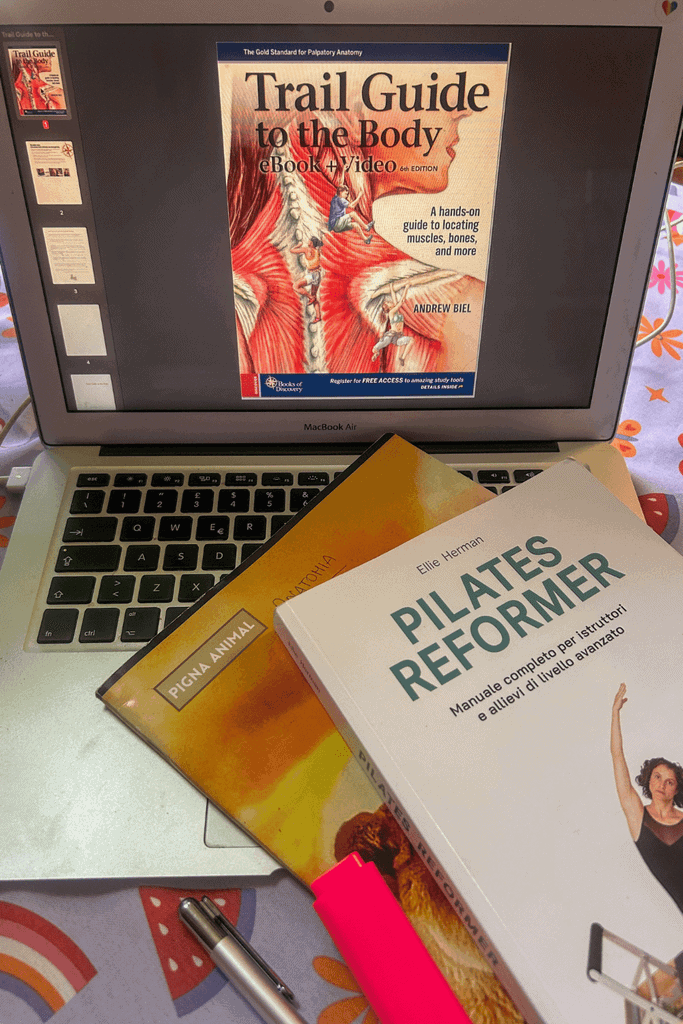
1. Trail Guide to the Body (Book)
The book Trail Guide to the Body is the best investment when it comes to anatomy self-study. I’ve seen many people suggest flashcards, but the book has so much more information, especially palpation tips (essential for postural analysis).
The written exam images are taken directly from this book, which takes out all the guesswork, and the information is organized in a much clearer way than in the Merrithew anatomy manual.
2. Trail Guide to the Body (Flashcards)
The flashcards are a great study resource if you like to quiz yourself and want to invest a little bit less. You’ll find flashcards for the skeletal system (Volume 1) and the muscles (Volume 2).
For your exams, you’ll need to memorize a specific list of muscles and bones (not all of them, and for the exact list you’ll need to follow the Merrithew anatomy manual).
That is why I still recommend getting the book (everything is in there), but the flashcards are great for testing your recall on the go.
3. Pilates Anatomy (Matwork)
Pilates Anatomy is the second book I read to understand anatomy applied to Pilates.
This book explains every single exercise in the traditional Mat Pilates repertoire in terms of the working muscles and types of contractions. It’s the ideal resource to start analyzing movement from an anatomical perspective.
4. Ellie Herman’s Pilates Reformer
I’ve always been very familiar with the Mat Pilates repertoire, but I felt like my Reformer classes were becoming a bit too hybrid, or I kept repeating the exact same exercises.
That’s why, right before my training, I invested in this book by Ellie Herman (a former dancer and renowned instructor trained by Kathy Grant and Romana Kryzanovska, two direct disciples of Joseph Pilates).
The book is incredibly useful if you’re training with STOTT because so many of the foundational exercises are identical (with a slight name change), while also introducing variations that will expand your repertoire when you begin teaching.
A Quick Note on STOTT Manuals
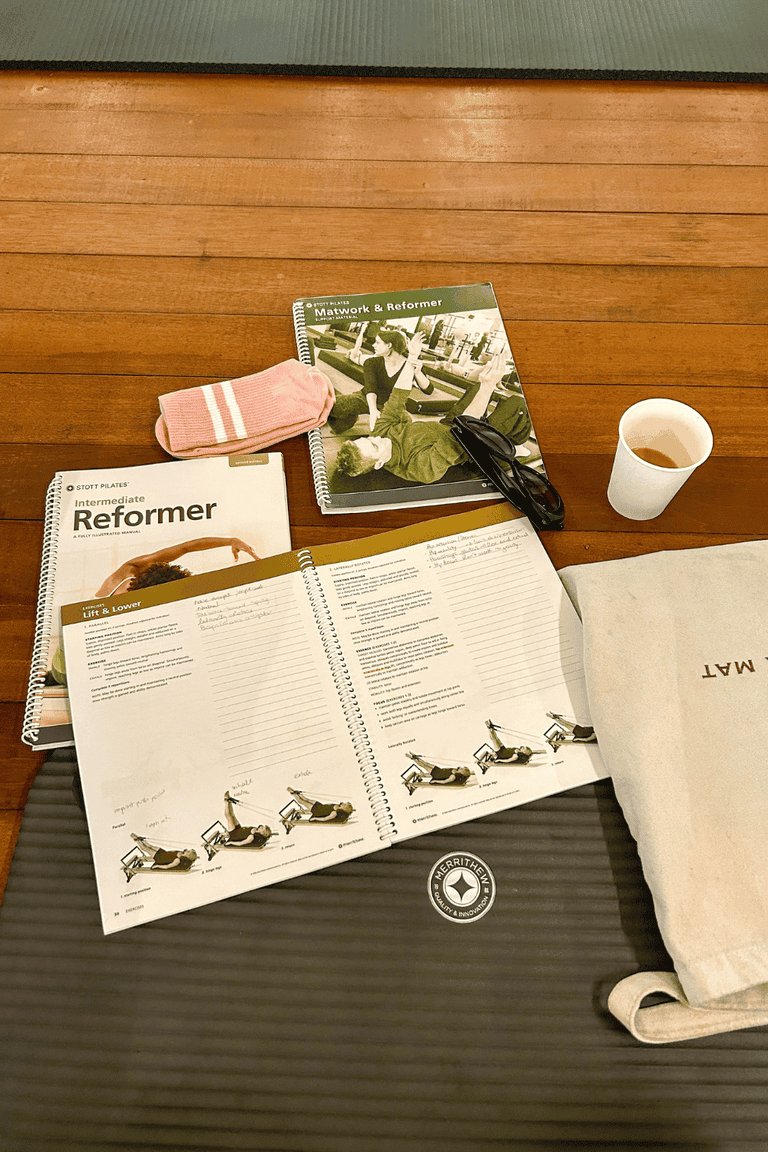
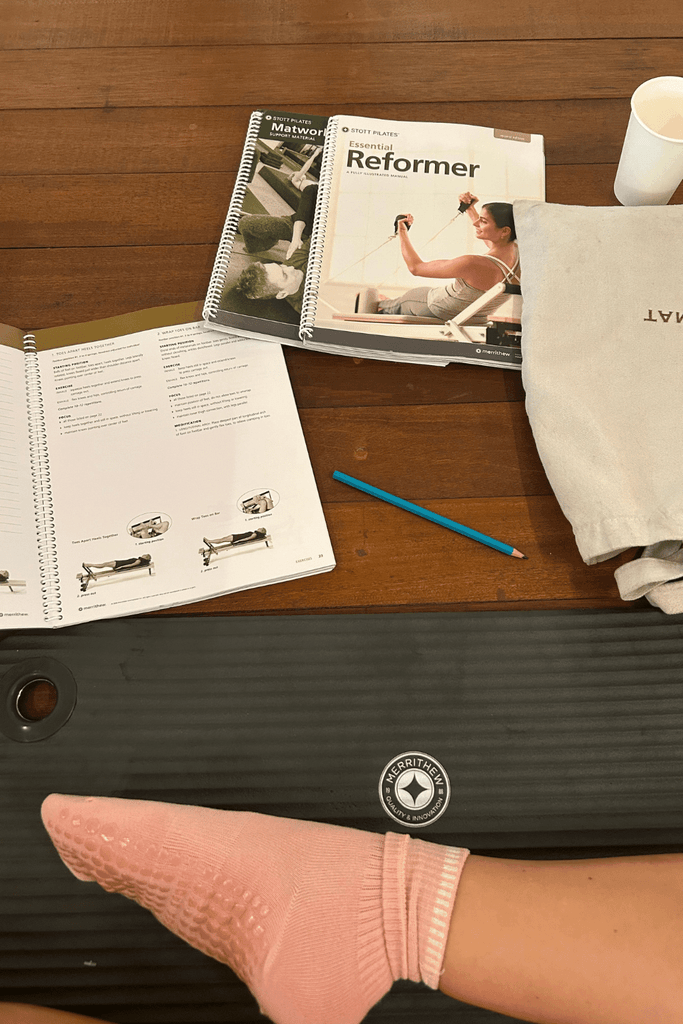
While STOTT manuals can be purchased in advance directly from the Merrithew website, check first whether they are already included in your course tuition, and confirm you are getting the latest edition rather than buying an older print right before an update.
That’s it for today’s guide on how to ace your STOTT PILATES teacher training! I answer some of the most common questions about starting your training journey in this FAQ STOTT Training guide.
If you’re wondering about the skill level of students entering the course, there truly is no single answer…it’s incredibly varied.
If I have to be completely honest, seeing where I stood compared to some of my classmates gave me so much confidence. It reassured me that I was in the exact right place at the right time, even without prior teaching experience.
If you have any other questions about STOTT PILATES or doing your training abroad, leave a comment below or send me a DM on Instagram @aribrnc. I’d love to connect!